

South Carolina ranks among the states with the highest frequency of traffic collisions in the United States, with data from the Department of Motor Vehicles indicating that over 200,000 crashes are reported annually across the state. This high volume of accidents creates a complex landscape for victims seeking compensation. Understanding your legal and insurance options immediately following a collision is critical to protecting your financial future and physical recovery. The path to recovery is rarely straightforward, but knowing your rights under South Carolina law provides the necessary leverage to secure fair treatment from insurance adjusters and opposing parties.
Understanding South Carolina's Fault-Based System
South Carolina operates under a traditional tort-based liability system, not a no-fault system. This distinction is fundamental to your legal strategy. In a no-fault state, your own insurance pays for your medical bills regardless of who caused the accident. In South Carolina, the driver who caused the crash is legally responsible for the resulting damages. This means you have the right to seek compensation directly from the at-fault driver's insurance policy.
However, this system also means you must prove liability to recover damages. Establishing fault requires a thorough investigation of the accident scene, witness statements, and police reports. Without clear evidence of the other party's negligence, your claim may be denied or significantly reduced. This is why immediate legal guidance is often necessary to preserve evidence before it disappears.
First-Party PIP Coverage Options
Even in a fault-based state, your own insurance policy may offer First-Party Personal Injury Protection (PIP) coverage. PIP is designed to cover medical expenses and lost wages regardless of who caused the accident. While South Carolina does not mandate PIP for all drivers, many policies include it as an optional add-on or standard feature depending on the insurer.
If you have PIP coverage, you can file a claim with your own insurance company immediately. This provides faster access to funds for medical treatment, which is crucial in the early stages of recovery. However, relying solely on PIP has limitations. PIP coverage limits are often lower than liability limits, and it does not compensate for pain and suffering. Therefore, PIP should be viewed as a temporary bridge to financial stability, not a long-term solution for serious injuries.
Filing Third-Party Liability Claims
The most common route for compensation in South Carolina is filing a third-party liability claim against the at-fault driver's insurance provider. This process involves submitting a detailed claim that includes medical records, repair estimates, and documentation of lost income. The insurance adjuster will investigate the claim to determine the extent of the at-fault driver's liability.
Insurance companies are businesses designed to minimize payouts. They may attempt to dispute liability or undervalue your injuries. A Charleston car accident lawyer can help navigate these negotiations, ensuring that your claim reflects the true cost of your injuries and losses. This includes future medical needs, long-term rehabilitation, and non-economic damages like pain and suffering.
Uninsured Motorist Protection
One of the most significant risks in any car accident is hitting a driver who lacks adequate insurance coverage. South Carolina law requires drivers to carry minimum liability coverage, but many drivers fail to comply. If the at-fault driver is uninsured or underinsured, your own Uninsured Motorist (UM) coverage becomes your primary source of compensation.
UM coverage steps in to pay for your medical bills, lost wages, and other damages when the other party cannot. It is essential to review your policy limits carefully, as UM coverage limits must match your liability limits in many cases. If you were involved in a collision with an uninsured driver, filing a claim under your UM policy is a critical step in securing your financial recovery. For more details on this specific scenario, you can read our guide on holiday safety tips and accident preparedness.
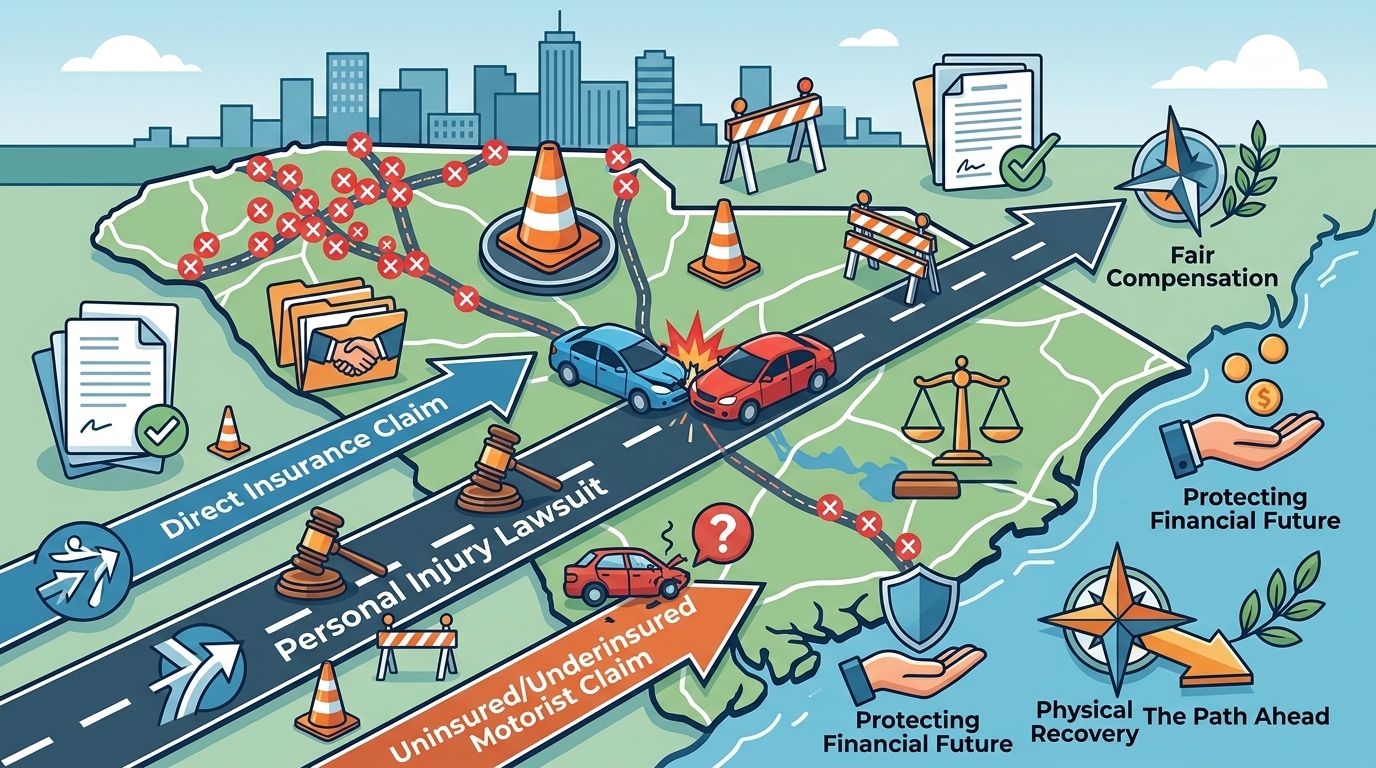
Comparing Your Claim Options
Choosing the right path for your claim depends on several factors, including the severity of your injuries, the clarity of liability, and your insurance policy details. The table below summarizes the key differences between the primary options available to South Carolina accident victims.
| Claim Option | Primary Purpose | Pros | Cons |
|---|---|---|---|
| First-Party PIP | Immediate medical expense coverage | Fast access to funds; no fault determination needed | Lower limits; no pain and suffering compensation |
| Third-Party Liability | Full compensation for damages | Higher potential payout; covers pain and suffering | Lengthy process; requires proof of fault |
| Uninsured Motorist (UM) | Protection against uninsured drivers | Essential safety net; covers similar damages to liability | Complex negotiations; requires proof of other driver's status |
Key Takeaways
- South Carolina is a fault-based state, meaning the at-fault driver is legally responsible for damages.
- First-Party PIP coverage offers quick access to medical funds but does not cover pain and suffering.
- Third-party liability claims are the standard route for full compensation but require proof of negligence.
- Uninsured Motorist coverage is vital if the at-fault driver lacks insurance.
- Insurance adjusters may attempt to minimize payouts; legal representation is often necessary.
- Christmas Injury Lawyers has secured over $10 million in settlements for clients in South Carolina.
- Immediate documentation of the accident scene is crucial for establishing liability.
Frequently Asked Questions
How long do I have to file a car accident claim in South Carolina?
South Carolina generally has a three-year statute of limitations for personal injury claims. However, filing sooner is always better to preserve evidence and witness memories.
What if the other driver has no insurance?
If the other driver is uninsured, you can file a claim under your own Uninsured Motorist (UM) coverage. This coverage is designed specifically for this scenario.
Do I need a lawyer to file a claim?
While you can file a claim yourself, complex cases involving serious injuries or disputed liability often benefit from professional legal representation to ensure fair compensation.
What damages can I recover in a South Carolina car accident?
You can recover economic damages like medical bills and lost wages, as well as non-economic damages like pain and suffering, depending on the severity of your injuries.
How does comparative negligence affect my claim?
South Carolina follows a modified comparative negligence rule. If you are found to be partially at fault, your compensation may be reduced by your percentage of fault, but you can still recover if you are less than 51% at fault.
What if I was injured in a construction accident instead?
Construction accidents fall under workers' compensation laws. You can learn more about your rights in our guide on construction accident legal options.
Can I sue the government for a car accident?
Suing a government entity involves strict notice requirements and shorter deadlines. It is critical to consult with an attorney immediately if a government vehicle or property is involved.
Contact Christmas Injury Lawyers
Navigating the aftermath of a car accident in South Carolina can be overwhelming. You do not have to face insurance companies and legal complexities alone. At Christmas Injury Lawyers, we are dedicated to fighting for the injured and their families. Our team has over 25 years of experience helping clients in Charleston, Columbia, Mount Pleasant, and Summerville secure the compensation they deserve.
Do not wait until it is too late to protect your rights. Contact us today for a free consultation. Call (843) 535-8000 or visit our contact page to schedule your appointment. Let us help you restore your peace of mind.