

What is the process for filing a Jones Act Seamen claim for maritime injuries in South Carolina?
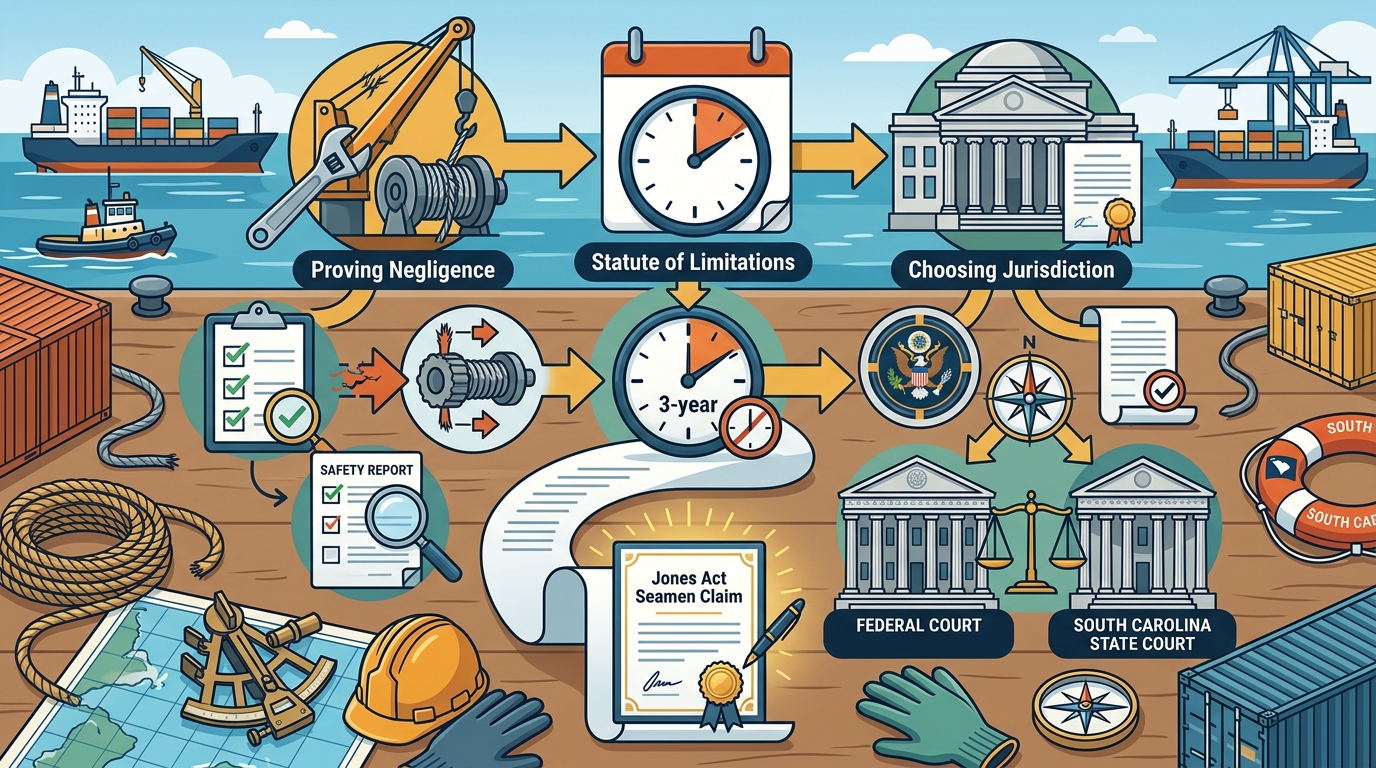
The process for filing a Jones Act Seamen claim in South Carolina involves proving that the vessel owner was negligent, filing within a strict three-year statute of limitations, and choosing between federal or state court jurisdiction. This guide covers the essential legal steps, deadlines, and venue options for maritime workers injured in South Carolina waters.
Negligence Lawsuit Filing
Filing a Jones Act claim requires establishing that the employer or vessel owner was negligent. Negligence is the failure to exercise the care that a reasonably prudent person would exercise in the same circumstances. In maritime law, this standard is applied to the shipowner's duty to provide a safe working environment. The injured seaman must prove that the employer's actions or inactions directly caused the injury.
Proving Employer Negligence
To succeed in a negligence lawsuit, the plaintiff must demonstrate four elements: duty, breach, causation, and damages. The shipowner has a duty to maintain a seaworthy vessel. A breach occurs when the vessel is not seaworthy or when the crew is not properly trained. Causation links the breach to the specific injury. Damages include medical bills, lost wages, and pain and suffering.
The Unseaworthiness Doctrine
Unlike standard negligence, the unseaworthiness doctrine is a strict liability standard. Unseaworthiness is the condition of a vessel that is not reasonably fit for its intended service. If a vessel is unseaworthy, the owner is liable for injuries caused by that condition, regardless of whether they were negligent. This doctrine provides a powerful tool for seamen to recover compensation for injuries caused by defective equipment, inadequate training, or unsafe working conditions.
Statute of Limitations
The statute of limitations for a Jones Act claim is three years from the date of the injury. This deadline is strict and non-negotiable. If a seaman fails to file a lawsuit within this period, the claim is barred, and the court will dismiss the case. The three-year period begins on the day the injury occurred, not the day the injury was diagnosed or the day the seaman realized the extent of the damage.
Why Deadlines Matter
Missing the statute of limitations is one of the most common reasons maritime claims are denied. Evidence fades, witnesses forget, and documents are lost over time. Filing early preserves the right to sue and allows the legal team to gather evidence while it is still fresh. It also puts the insurance company on notice that a claim is being pursued.
Exceptions and Tolling
In rare cases, the statute of limitations may be tolled, or paused. This can happen if the injured party was a minor or legally incompetent at the time of the injury. It can also occur if the defendant fraudulently concealed the injury. However, these exceptions are narrow and difficult to prove. Seamen should not rely on tolling and should file their claims well before the three-year deadline.
Court Jurisdiction
Jones Act claims can be filed in either federal or state court. The choice of venue depends on the specific facts of the case and the strategy of the legal team. Federal courts have original jurisdiction over Jones Act cases because they arise under federal maritime law. State courts also have concurrent jurisdiction, meaning they can hear these cases as well.
Federal vs. State Court
Filing in federal court often results in a faster trial and a more predictable outcome. Federal judges are experienced in maritime law and apply federal standards consistently. State courts may be more familiar with local conditions and may have different procedural rules. The choice of venue can affect the jury pool, the speed of the case, and the final award.
Choosing the Right Venue
The decision to file in federal or state court should be made after a thorough analysis of the case. Factors to consider include the location of the injury, the residence of the parties, and the complexity of the legal issues. A skilled maritime attorney can evaluate these factors and recommend the best venue for the client's interests.
| Factor | Federal Court | State Court |
|---|---|---|
| Jurisdiction | Original jurisdiction under federal maritime law | Concurrent jurisdiction |
| Judge Experience | High, specialized in maritime law | Variable, depends on local court |
| Procedural Rules | Federal Rules of Civil Procedure | State Rules of Civil Procedure |
| Jury Pool | Federal district | State county |
Key Takeaways
- The Jones Act allows seamen to sue their employers for negligence.
- The statute of limitations is three years from the date of injury.
- Claims can be filed in federal or state court.
- Unseaworthiness is a strict liability standard that benefits seamen.
- Early filing preserves evidence and strengthens the case.
- Choosing the right venue is a strategic decision.
- Consulting a maritime attorney is essential for a successful claim.
Frequently Asked Questions
What is the Jones Act?
The Jones Act is a federal law that allows seamen to sue their employers for injuries caused by negligence or unseaworthiness.
Who qualifies as a seaman?
A seaman is a person who spends at least 30% of their working time on a vessel in navigable waters and contributes to the vessel's function.
How long do I have to file a claim?
You have three years from the date of the injury to file a Jones Act claim.
Can I file in state court?
Yes, Jones Act claims can be filed in either federal or state court.
What damages can I recover?
You can recover medical expenses, lost wages, pain and suffering, and loss of earning capacity.
Do I need a lawyer?
Yes, maritime law is complex, and a skilled attorney is essential to navigate the legal process and maximize your recovery.
Conclusion
Filing a Jones Act Seamen claim in South Carolina requires a clear understanding of negligence, strict deadlines, and court jurisdiction. By acting quickly and choosing the right venue, injured seamen can secure the compensation they deserve. For expert guidance on maritime injury claims, contact Christmas Injury Lawyers today.