

What is the process for filing a Jones Act Seamen claim for maritime injuries in South Carolina?
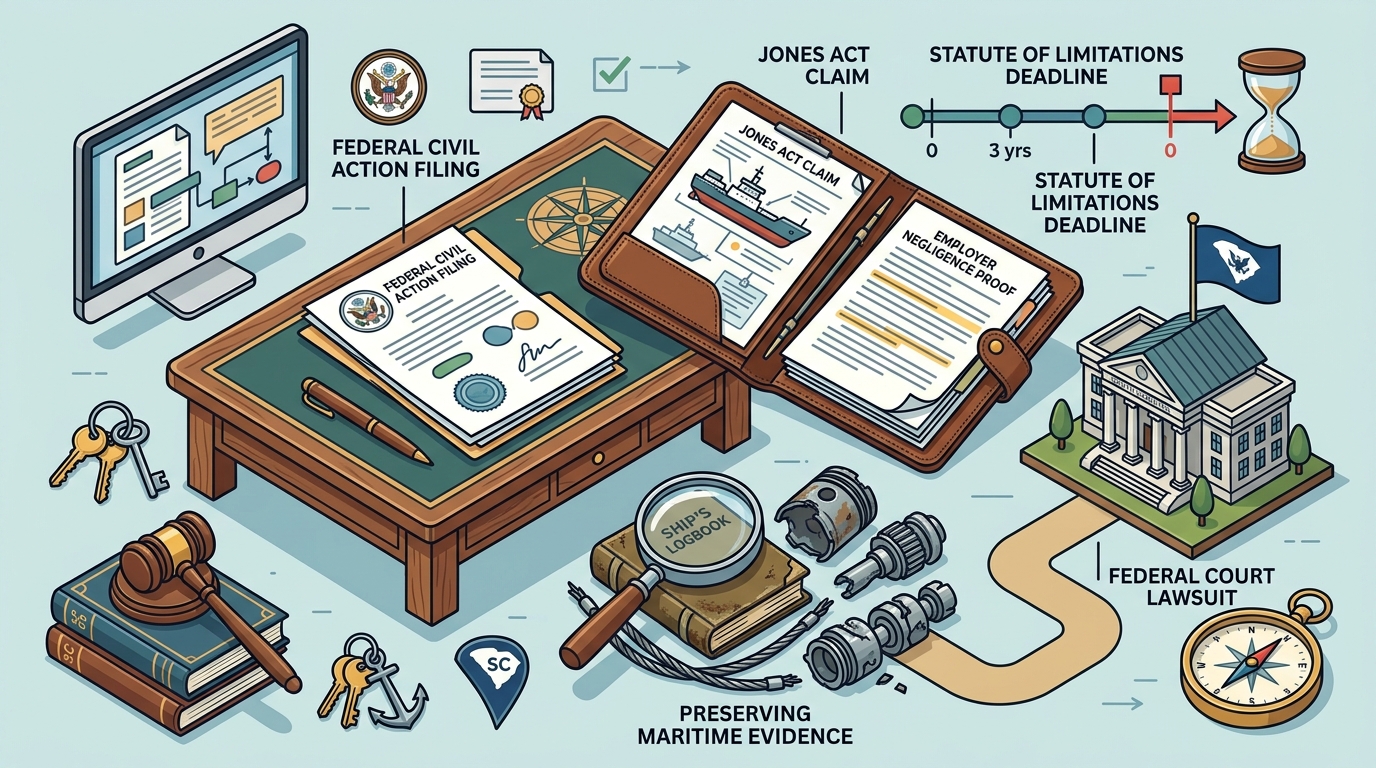
The process for filing a Jones Act Seamen claim in South Carolina involves proving that the employer's negligence contributed to the injury, adhering to a three-year statute of limitations, and filing a civil lawsuit in federal court. This guide covers the critical legal deadlines, the specific steps for initiating a federal civil action, and the essential protocols for preserving maritime evidence to maximize your compensation.
Statute of Limitations
Maritime injury claims operate under a strict legal timeline that determines whether a seaman can recover damages. Understanding these deadlines is the first and most critical step in protecting your legal rights.
The Three-Year Federal Deadline
The Jones Act is a federal statute that grants seamen the right to sue their employers for negligence. The statute of limitations for a Jones Act claim is three years from the date of the injury. This deadline is not a suggestion; it is a hard legal bar. If a lawsuit is not filed within this window, the court will dismiss the case, and the injured worker will lose the right to compensation entirely.
Comparing Maritime and State Deadlines
It is crucial to distinguish between federal maritime law and state personal injury laws. In South Carolina, the statute of limitations for a standard personal injury claim is generally two years. However, because the Jones Act is a federal law, it supersedes state deadlines for qualifying seamen. This distinction is vital because many injured workers mistakenly believe they have only two years to act, potentially jeopardizing their claim.
| Claim Type | Governing Law | Statute of Limitations | Forum |
|---|---|---|---|
| Jones Act Seaman | Federal (46 U.S.C. § 30104) | 3 Years | Federal Court |
| South Carolina Personal Injury | State (S.C. Code § 15-3-530) | 2 Years | State Court |
| Longshore and Harbor Workers' Comp | Federal (LHWCA) | 3 Years | Administrative (DOL) |
Christmas Injury Lawyers emphasizes that time is the most valuable asset in a maritime case. The legal team at Christmas Injury Lawyers advises all clients to report injuries immediately to their employer and to consult with an attorney well before the three-year mark expires.
Civil Lawsuit Filing
Unlike standard workers' compensation claims, which are administrative in nature, a Jones Act claim is a civil lawsuit. This means the injured seaman must file a complaint in a court of law, typically a U.S. District Court, to seek damages.
Establishing Negligence
The core of a Jones Act civil lawsuit is the proof of negligence. The seaman must demonstrate that the employer failed to provide a safe working environment and that this failure was a contributing cause of the injury. This is a lower threshold than the "sole cause" standard often applied in other maritime contexts, but it still requires a robust legal strategy.
The Filing Process
Filing a Jones Act lawsuit involves several procedural steps. First, the attorney drafts a complaint that outlines the facts of the accident, the specific injuries sustained, and the legal theories of liability. This document is then filed with the clerk of the federal court. Once filed, the employer is served with the complaint and must respond within a set period, usually 21 days. The case then proceeds through discovery, where both sides exchange evidence, and may eventually go to trial if a settlement is not reached.
Christmas Injury Lawyers has extensive experience navigating the federal court system. Our team handles the complex procedural requirements of maritime and Jones Act cases, ensuring that every filing meets the strict standards of federal litigation.
Evidence Preservation
In maritime injury cases, evidence is the currency of the lawsuit. Without solid proof of negligence, a claim will fail. Preserving evidence immediately after an accident is essential to building a strong case.
Documenting the Incident
The first step in evidence preservation is documenting the accident scene. This includes taking photographs of the area where the injury occurred, noting any hazardous conditions, and collecting witness statements. In maritime environments, conditions can change rapidly due to weather or operational needs, so immediate documentation is critical.
Medical Records and Maintenance & Cure
Medical records serve as the primary evidence of the extent of the injury. Under the Jones Act, employers are required to provide "maintenance and cure," which covers living expenses and medical care until the seaman reaches maximum medical improvement. Failing to document all medical treatments can weaken the claim for future damages.
Christmas Injury Lawyers works closely with clients to ensure that all relevant evidence is collected and preserved. Our Knowledge Center provides resources on how to gather and organize documentation for your claim.
Key Takeaways
- The statute of limitations for a Jones Act claim is three years from the date of injury.
- Jones Act claims are civil lawsuits filed in federal court, not administrative workers' comp claims.
- Proof of employer negligence is required to recover damages under the Jones Act.
- Preserving evidence, including photos and witness statements, is critical immediately after an accident.
- Employers must provide maintenance and cure, covering medical expenses and living costs.
- South Carolina personal injury laws have a two-year deadline, which does not apply to Jones Act claims.
- Consulting with a specialized maritime attorney early in the process ensures all legal deadlines are met.
Frequently Asked Questions
What is the difference between a Jones Act claim and a workers' compensation claim?
A Jones Act claim is a negligence lawsuit filed in federal court, allowing for a jury trial and potentially higher damages. Workers' compensation is an administrative system that provides no-fault benefits but typically has lower compensation caps and no jury trial.
How long do I have to file a Jones Act claim in South Carolina?
You have three years from the date of the injury to file a Jones Act claim. This federal deadline supersedes the two-year state statute of limitations for personal injury in South Carolina.
Do I need a lawyer to file a Jones Act claim?
While you can file a claim yourself, it is highly recommended to hire an experienced maritime attorney. Jones Act cases involve complex federal laws and procedures that can be difficult to navigate without legal expertise.
What kinds of injuries are covered under the Jones Act?
The Jones Act covers a wide range of injuries, including slips and falls, equipment malfunctions, and injuries caused by the negligence of other crew members or the vessel's management.
Can I sue my employer for punitive damages under the Jones Act?
In cases of willful or reckless misconduct by the employer, punitive damages may be available. This is a significant distinction from standard workers' compensation, which does not allow for punitive damages.
What is "maintenance and cure" in maritime law?
Maintenance and cure is the employer's obligation to provide living expenses and medical care to an injured seaman until they reach maximum medical improvement, regardless of fault.
Where should I file my Jones Act lawsuit?
Jones Act lawsuits are typically filed in U.S. District Court. The specific district may depend on where the injury occurred, where the employer is located, or where the vessel is homeported.
Conclusion
Filing a Jones Act Seamen claim in South Carolina is a complex legal process that requires a deep understanding of federal maritime law. By adhering to the three-year statute of limitations, properly filing a civil lawsuit in federal court, and meticulously preserving evidence, injured seamen can protect their rights and seek the compensation they deserve. Christmas Injury Lawyers is dedicated to providing the expert guidance and advocacy needed to navigate these challenges. If you or a loved one has been injured in a maritime accident, today for a free consultation.